Neoliberalism's Demons by Adam Kotsko
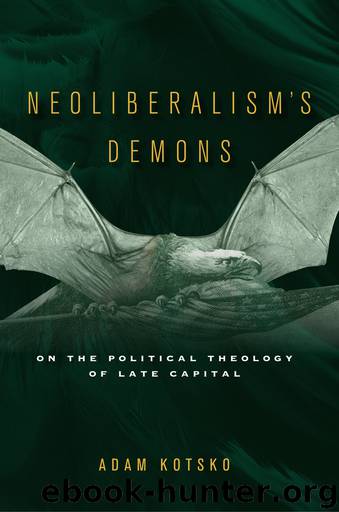
Author:Adam Kotsko [Kotsko, Adam]
Language: eng
Format: epub
Publisher: Stanford University Press
Published: 2018-11-17T16:00:00+00:00
CHAPTER 4
THIS PRESENT DARKNESS
In 1989 Francis Fukuyama published an essay entitled “The End of History?”1 Though the 1992 book-length version of the argument is better-known, the shorter essay is an interesting document in its own right. Coming before the fall of the Berlin Wall (which would happen in November of that year), much less the dissolution of the Soviet Union itself (which would endure through 1991), it is more cautious than one would expect from the book’s subsequent reputation. Where the latter appeared in the context of triumphalism, as Americans came to believe that they had “won” the Cold War, the shorter essay focuses more on “the total exhaustion of viable systematic alternatives to Western liberalism.” On the basis of this ambiguous victory in an ideological war of attrition, Fukuyama claims that “we may be witnessing . . . the end point of mankind’s ideological evolution and the universalization of Western liberal democracy as the final form of human government” (1).
This one-sided emphasis on liberal democracy as a political ideal is strange, given the primary evidence Fukuyama adduces for the global triumph of Western thought is precisely the spread of Western commercial culture: experimentation with markets in the Soviet Union, the popularity of Western classical music in Japan, “and the rock music enjoyed alike in Prague, Rangoon, and Tehran.” And though he attempts to obscure it somewhat through his idiosyncratic descriptions, the narrative arc he supplies for the twentieth century is one in which politics and economics are deeply intertwined:
The twentieth century saw the developed world descend into a paroxysm of ideological violence, as liberalism contended first with the remnants of absolutism, then bolshevism [sic] and fascism, and finally to an updated Marxism that threatened to lead to the ultimate apocalypse of nuclear war. But the century that began full of self-confidence in the ultimate triumph of Western liberal democracy seems at its close to be returning full circle to where it started: not to an “end of ideology” or a convergence between capitalism and socialism, as earlier predicted, but to an unabashed victory of economic and political liberalism. (1)
In terms of the main events, this is a narrative that critics and exponents of neoliberalism would recognize. Yet both would equally object to the idea that “economic and political liberalism” was somehow passively waiting for the various alternatives to exhaust themselves. As we have seen, the return to a new version of classical liberalism at the end of the twentieth century was not the simple reemergence of something that had always been lurking in the background but the result of an aggressive political movement. Fukuyama knows this very well, because he had not only witnessed that transformation—as a member of the Reagan administration, he actively participated in it.
Hence Marika Rose is right to connect Fukuyama’s “end of history” thesis to the triumph not of liberal democratic political institutions but of neoliberalism.2 And Fukuyama is actively contributing to the “end of history” that he claims to be documenting, insofar as he
Download
This site does not store any files on its server. We only index and link to content provided by other sites. Please contact the content providers to delete copyright contents if any and email us, we'll remove relevant links or contents immediately.
The Secret Power of Speaking God's Word by Joyce Meyer(3231)
Signature in the Cell: DNA and the Evidence for Intelligent Design by Stephen C. Meyer(3141)
Real Sex by Lauren F. Winner(3026)
The Holy Spirit by Billy Graham(2955)
The Gnostic Gospels by Pagels Elaine(2537)
Jesus by Paul Johnson(2366)
Devil, The by Almond Philip C(2338)
23:27 by H. L. Roberts(2255)
The Nativity by Geza Vermes(2234)
All Things New by John Eldredge(2167)
Chosen by God by R. C. Sproul(2166)
Angels of God: The Bible, the Church and the Heavenly Hosts by Mike Aquilina(1970)
The Return of the Gods by Erich von Daniken(1948)
Angels by Billy Graham(1929)
Knowing God by J.I. Packer(1861)
Jesus of Nazareth by Joseph Ratzinger(1813)
The Gnostic Gospel of St. Thomas by Tau Malachi(1800)
Evidence of the Afterlife by Jeffrey Long(1793)
How To Be Born Again by Billy Graham(1786)
